How to Solve a Profitability Case Study: A Complete Guide for Product Managers
Nov 17, 2025
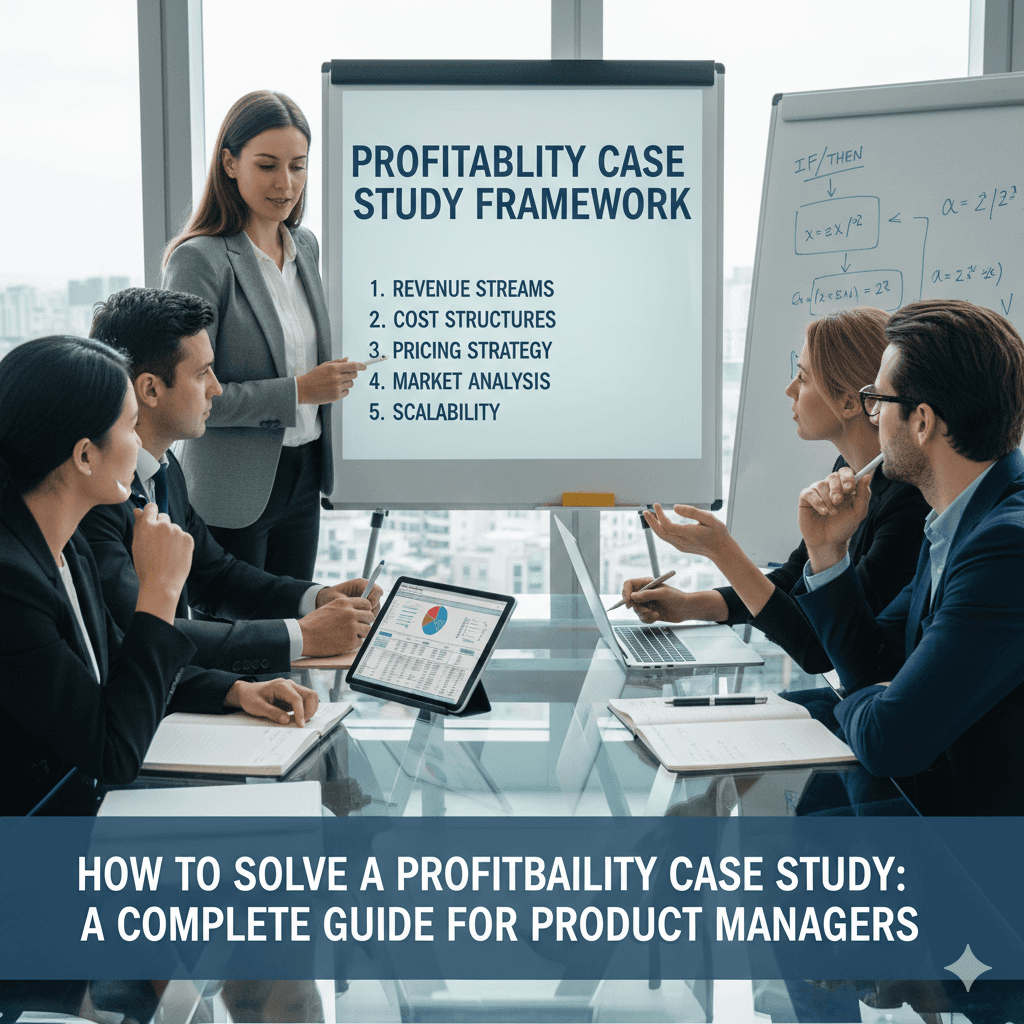
Landing a product management or consulting role often means tackling one of the toughest parts of the interview process, the profitability case study. These questions are designed to test not only your analytical thinking but also your business acumen, creativity, and communication skills.
Whether you’re preparing for a product management interview or a strategy role, mastering how to solve a profitability case study can make all the difference. With structured thinking, the right frameworks, and AI-driven interview preparation tools like PrepFirst.ai, you can turn complex case questions into opportunities to impress your interviewer.
In this guide, we’ll explore what profitability case studies are, how to approach them step-by-step, and how AI can help you practice and perfect your responses.
Understanding Profitability Case Studies
Before diving into how to solve them, let’s understand what a profitability case study really is.
A profitability case typically asks you to analyze why a company’s profits are declining or how profits can be increased. You are expected to identify key issues, structure your thoughts logically, and propose actionable solutions.
For product managers, these cases often tie back to product performance, customer retention, or monetization strategies.
Interviewers use these cases to evaluate:
Your analytical and logical reasoning
Your understanding of business fundamentals
Your ability to break down complex problems
And most importantly, your communication clarity
In short, a profitability case is not just about math — it’s about storytelling with insight.
The Profitability Framework: Your Go-To Structure
When it comes to solving profitability case studies, using a clear and logical framework is key. The most common approach is breaking profit into two main levers:
Profit = Revenue – Costs
From here, you can dig deeper into both sides of the equation:
1. Revenue Analysis
Ask questions like:
Has total revenue dropped, or has growth stagnated?
Which product lines, customer segments, or regions are affected?
Is the decline due to volume, price, or both?
2. Cost Analysis
Then move on to:
Are fixed or variable costs increasing?
Have there been operational inefficiencies or supply chain issues?
Are there external factors, like market or regulatory changes, affecting margins?
This simple but powerful structure helps you guide the conversation logically and ensures you don’t miss critical areas.
PrepFirst.ai’s AI interview preparation tool can simulate these case studies and provide real-time feedback on how you structure and communicate your responses, helping you refine your delivery before your actual interview.
How to Approach a Profitability Case Step-by-Step?
Let’s look at how to systematically approach a profitability case study in an interview.
Step 1: Clarify the Objective
Start by asking clarifying questions. For example:
“Are we focusing on a specific product or the entire business line?”
“Is the goal to identify the reason for the profit decline or to propose solutions?”
This shows that you think critically and are detail-oriented, two traits interviewers love.
Step 2: Structure Your Framework
Lay out your approach before diving into numbers. You can use the Revenue-Cost framework, or even complement it with the 3Cs (Company, Customers, Competition) or 4Ps (Product, Price, Place, Promotion) frameworks for deeper analysis.
Step 3: Analyze the Data
Work through each part of your framework logically. For instance:
If revenue dropped, check whether it’s due to lower sales volume or reduced pricing.
If costs rose, identify whether fixed costs (e.g., rent, salaries) or variable costs (e.g., production, logistics) are responsible.
Step 4: Synthesize and Recommend
Once you’ve diagnosed the issue, summarize your findings clearly. Then, propose practical solutions that balance business goals and user needs.
For example:
Introduce a new pricing model to increase margins.
Optimize operational costs through automation.
Redesign a low-performing product to improve customer engagement.
This final synthesis step is where many candidates stumble, and it’s exactly what you can perfect using AI feedback on PrepFirst.ai, which analyzes clarity, logic, and confidence in your delivery.
Common Mistakes in Profitability Case Interviews
Even strong candidates can make mistakes under pressure. Here are a few pitfalls to avoid:
Jumping into solutions too quickly: Always diagnose before prescribing.
Ignoring the qualitative side: Data matters, but so does understanding customer behavior and market trends.
Failing to communicate structure: Interviewers should easily follow your reasoning.
Not quantifying your impact: Always use numbers to show business outcomes.
Practicing case studies with AI mock interviews allows you to identify and correct these weaknesses in a safe, guided environment.
How AI Interview Preparation Can Help You Master Profitability Cases?
In today’s competitive hiring landscape, traditional interview prep alone isn’t enough. That’s where AI tools like PrepFirst.ai come in.
Here’s how AI transforms the way you prepare for profitability case interviews:
1. Simulated Case Scenarios
PrepFirst.ai offers AI-generated profitability case prompts based on real-world company challenges. You can practice live and get immediate insights into your reasoning style.
2. Real-Time Feedback
Using natural language processing, the platform provides feedback on your content clarity, logic, and tone. It even highlights filler words or unclear phrases that may weaken your answer.
3. Performance Analytics
Get detailed analytics on your performance, how structured your answers are, your confidence levels, and improvement over time.
4. Personalized Improvement Plans
AI doesn’t just point out mistakes; it also suggests how to fix them. For example, if your cost analysis is weak, it may recommend focusing more on operational or fixed cost breakdowns in future attempts.
By practicing regularly on PrepFirst.ai, you can internalize frameworks, refine your communication, and enter interviews with confidence and clarity.
Bringing It All Together: Frameworks + AI = Interview Success
Solving a profitability case study successfully requires a combination of analytical frameworks, business intuition, and clear communication.
Here’s the winning formula:
Framework: Start with a clear structure, revenue vs. cost.
Insight: Identify underlying causes using product and market context.
Solution: Present actionable, data-backed recommendations.
AI Practice: Use PrepFirst.ai’s mock interviews and AI feedback to polish your delivery.
The best candidates aren’t just analytical, they’re adaptive storytellers who can translate numbers into business impact.
Final Thoughts
Profitability case studies are a staple in product management and consulting interviews because they reveal how you think under pressure. The good news is, with a structured approach and consistent practice, anyone can master them.
By combining classic product management frameworks with AI-powered coaching from PrepFirst.ai, you can learn to analyze problems logically, communicate confidently, and deliver insights that resonate with interviewers.
So, next time you face a profitability question, don’t panic. Structure your answer, think through the numbers, and tell a clear, impactful story. Because in every great product manager’s toolkit, clarity and confidence are just as valuable as analysis, and with the right preparation, you’ll shine in both.